Friday, April 22, 2011

Advertisements as Art

        To make art.
        To look at art.
        To think about art.
        To speak about art.

During my first methods class, I observed a recent grad teaching at an elementary school in Phoenixville, Pennsylvania. Something she said stuck with me. She told me that most adults don't spend their time making art, but they do look, think, and speak. She wanted to teach her students how to interact with art for the rest of their life, and in the manners in which they would interact---looking, thinking, speaking---not just making!

Of course there is a place for making. I spend most of my art classes making. But I've also expanded what we make beyond your traditional fine art.

Design education
is a huge topic and I won't begin to scratch the surface, but one way to think about it is making images (2D), objects (3D), places (3D), and experiences (4D). My students are exposed to graphic design (images), product design (objects), and architecture (places).

To begin to understand principles of art in graphic design, 5th graders analyze magazine advertisements. They sketch layouts, identify color palettes, and answer questions about style (text and images) and principles (repetition, emphasis, balance, proportion). Student then use a favorite advertisement as a template for advertising one of our Expected Schoolwide Learning Results (ESLRs).

The students create their advertisements in PowerPoint. We change the slide size and orientation, then use AutoShapes, Clip Art, and Text Boxes to create the ad. I like that the program is quicker to pick up than Photoshop, Illustrator, or InDesign. The skills they learn will transfer well to other Microsoft programs, which is handy as they enter middle school.

I do not allow the students to get images on the internet for numerous reasons, including the questionable results sprinkled in any Google image search and the quality of most of the images. If they cannot find what they want in clip art, I search for free stock photos and drop them into their folder on the network. I also give them access to the school logo and the newly designed ESLR icon.


This ad is one of my favorites. I love the use of the ESLR icon above the words. Perfect substitute for the heart!
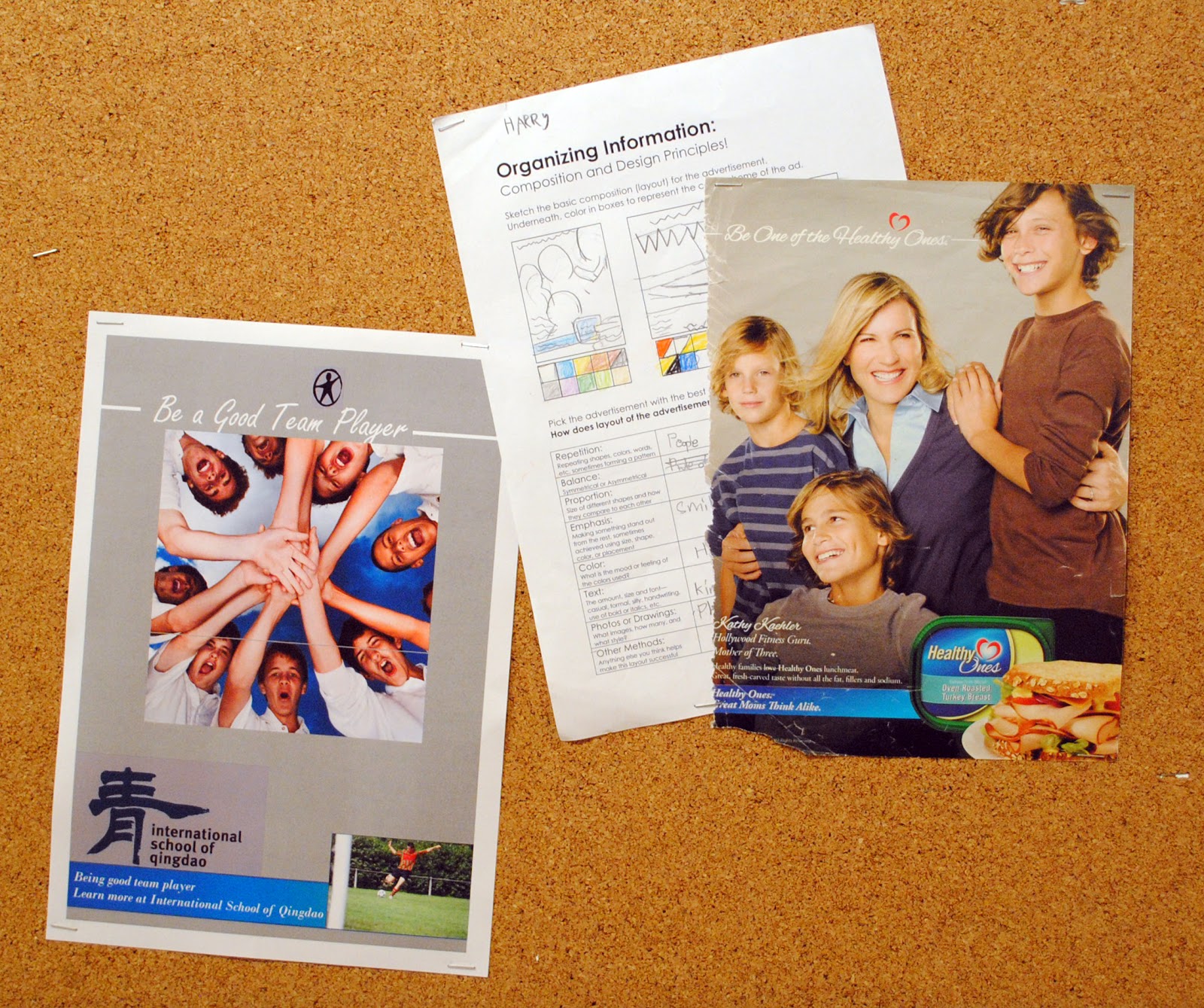

After the images are added, I let the students vary from the original color palette. This girl decided to make her advertisement more interesting by eliminating the all-white background and adding more layers.


We don't exactly have a baseball program at our school, but I like this advertisement about learning good sportsmanship in PE class.


Po, from our production of Snow White and the Seven Dwarfs, made this advertisement. He gave me a shout-out in his ad! He replaced Benjamin Bratt's name with his own name and "Inspired by a True Story" with "Inspired by Miss M." Unfortunately, I asked all the students to remove their names from the posters, only identifying the posters by our school, and not by the designer.


The Captain (Doc) from Snow White just loved this interactive advertisement. He suggested using the ESLR icon in place of the can of Chef Boyardee, which prompted me to make the icon available to all the students. We carefully crafted a phrase that would work on his advertisement both when folded and unfolded. I love the final result!


Sunday, April 17, 2011

School Supply Drawings

Drawing from direct observation is one of my Visual Arts Standards and Benchmarks and a passion of mine. My second graders draw the hallway (a project I did in high school), my third graders draw bicycles (another project I did in high school), my fourth graders draw their classmates (also a project I did in high school), and my fifth graders draw their hands (yet another project I did in high school).

I do not think they are too young for such academic, classic drawing tasks. They are so successful! Of course, we do other projects that engage their kid culture in the arts, but I love teaching students how to see and how to reproduce what they see on paper.

When I saw these observational drawings on the Briargrove Elementary Art Page, I knew I had to tackle such a project with my second grade students.

I loved the drawing challenges:

        draw at least one object larger than life
        draw at least one object cropped (going off the edge of the page)
        draw at least one object repeated (from observation again)


I didn't have shells, fake flowers, or an abundance of potted plants. Instead, I found our everyday materials: paintbrushes, paint bottles, scissors, compasses, pencil sharpeners, glue bottles, etc. (Not surprisingly, I also had to draw school supplies from direct observation in high school.) While there is a benefit to drawing organic items (no intimidating straight lines and more forgiveness in mistakes, especially when drawing directly in permanent marker), my students rose to the challenge.

We learned that to observe means to LOOK! They needed to be constantly looking at the object they were drawing.

To add interest, they used crayons to draw textures, patterns, and solid colors in the objects with one color family (warm, cool, or neutral). Using a different color family, they added textures and patterns to the background. Finally, they used watercolors to paint the areas that were not covered by crayon. The results are fabulous!

Saturday, April 16, 2011

Batiks of Baked Goodies

Last month, I had the privilege of spending five days in Shanghai for a "business trip." The first two days were spent at an ACAMIS (Association of Chinese and Mongolian International Schools) meeting, followed by a day of break (including a trip to IKEA), then two days observing art teachers at other international schools.

Monday was spent at Shanghai American School, Puxi Campus. The school is significantly older and larger than ours, with an elementary school that has two art teachers and an art TA. I first connected with one of their art teachers through her blog, Art is Messy. Her Malaysian Batik project impressed me two years ago. Last month, I was able to see another batik project, Peace Banners, installed in the entryway of the elementary building, and talk about the process in person.

A curious process, the batik uses a resist made of equal parts aloe vera lotion and toothpaste. I mixed the concoction in an empty paint bottle, then filled small glue bottles.

Third grade is using this process to complete their cake paintings. In the past, we have created tempera paintings based on Wayne Thiebaud's work, emphasizing drawing 3D solids (cylinder, triangular prism, etc.) and mixing colors (tints and shades).

This year, the students are creating batiks. After practicing in their sketchbooks, students drew their design on a large piece of matboard (40cm square with a 5cm margin). Pencil drawings were traced in permanent marker to be visible through the thin cotton muslin. I taped the fabric to the back of the matboard. Once the students' glue lines dry, they will be using tempera paint to fill in the sections. The final projects are soaked briefly in water, then rinsed under a faucet. The pressure of the water from the faucet is enough to remove the resist, exposing the unstained white fabric.


This week, I've been testing the process, working a few steps ahead of the students. I am so excited about the results! The 4th and 5th graders are as well, and begging to let them do a batik project. For now, I'm enjoying the sweet candy/toothpaste smell filling my classroom from the resist and trying to decide how we will display the final projects. Perhaps we'll have them made into pillows for the library!

Monday, April 11, 2011

in memory


I want to be eloquent. I want to be poetic. I want to be deep and spiritual and moving. But I don't know how to do it. I can't move on in this blog, go on to the "new normal," post about ceramics projects and observational drawings and crazy batiks until I've acknowledged what I never imagined.

So I sit and cry and just let you know that my student died. A quiet but oh so funny 5th grade boy. He was the son of a high school teacher, the younger brother of a middle school student, the older brother of an elementary student, the son of the PTO president, the classmate of the 5th graders, and the student of the elementary teachers. My student, for three years.

Before moving to China, I attended a two-week training with him, his family, and other new staff members. Three weeks later, on July 25, 2008, we met up in San Francisco and boarded the plane for our journey together to living abroad.

On Friday, March 25, during Parent/Teacher conferences, he was playing near his house and had a tragic accident. The injuries from his fall were unsurvivable. He was taken to the local hospital, then medi-evaced to Hong Kong, but the doctors in Hong Kong pronounced him dead on Tuesday, March 29.


This musically-talented, baseball-loving, quiet comedian will forever be part of my story of teaching ARTabroad.


In lieu of flowers, the family has established a fund to honor his memory and his love for music and the arts. The money will be used to purchase things that touched his life and that he loved, such as major instruments for the band program, special afterschool programs in music and the arts, etc.

Saturday, March 19, 2011

art.abroad

I don't read the news. I don't get newspapers. I don't access news websites. Apart from the brief period of time I was trying to watch the Colbert Report online daily, I get most of my news from Facebook (results on the Bachelor or American Idol, Philadelphia sports news, and the death of celebrities---all the things my generation finds important). But with recent changes in my ability to access my News Feed, I was off-line for almost a week. The same week that I traveled to Shanghai for an ACAMIS meeting and some observation and collaboration with elementary art teachers at local international school, and was thus cut off from the morning bus discussions--another news venue in my life.

A week later, I don't understand the magnitude of the natural disaster in Japan. Like an ostrich, I've buried my head in the sand, refusing to seek out information. I am not sure I want to understand the weight of the event.


Because of my traveling, I spent the first school day after the disaster at Shanghai American School, Puxi campus. The student body was more diverse than my school, especially among Westerners. Not knowing the kids' backgrounds, I couldn't identify the passport country of the Asian students. Until they opened their mouth. A few sweet kids, while working away on their art projects, would just start talking to me...

          "Did you know about the tsunami in Japan?"

          "My whole country is destroyed by tsunami."

          "Did you know about the earthquake in Japan? I'm from Japan. My uncle, aunt, and grandparents are there,
          but they're safe. There's no tsunami coming for now."


My heart broke, hearing their little voices. The fear, the anxiety, the uncertainty. Everyone in the school was affected, regardless of passport country. Many had been to Japan, all knew someone from Japan, and a few had loved ones currently living in Japan.

Yet I couldn't help but wonder if students in my home country even knew about the event. Did it affect school? Did it impact their childhood? Did they have any understanding of what was happening on the other side of the world?

I don't remember any global concerns from my childhood. I have some memories of US news: the Unibomber, Oklahoma City bombing, OJ's white SUV and trial, and September 11th in 10th grade. Perhaps some awareness of hurricanes in the states. Even living through an earthquake in San Francisco.

In college, there was the tsunami off the coasts of Indonesia, India and Sri Lanka.
          My first memory of a tragic event outside of my passport country.

Did nothing happen before that?

Certainly the world has become smaller, as information travels around the world in seconds. Tweets, pictures, and streaming video. I just finished reading Little Women and marveled at the letter writing from Europe to North America. The cost of travel, the sacrifice of relationships, the limited information. This week, a coworker from my school who lives one apartment building away here in China is in Ethiopia with his wife, picking up their son. Many miles away, they sat in the lobby, chatting with a family from my parents' church who are also adopting from Ethiopia, through the same organization, and ended up in country at the exact same time.

My circles are so small, and intersect over and over again.

          My brother's first friend from Pennsylvania currently teaches in Japan.
          I have four students from Japan.
          And did I mention yet that in Shanghai, I was staying with my friend from first grade?
               She is in her first year teaching internationally, and ironically teaching first grade.

In first grade, did I know Japan existed? I certainly had no connection to the country or its people.

My first grade students live a very different life. A few weeks ago, one American boy was walking with his dad past a mural in the secondary building. The mural has been there as long as I've been at the school, and he has probably walked past it hundreds of time. But it struck him in that instant---he was looking at famous landmarks from around the world. And he knew them, by name. I don't know all the names of the places, but at seven years old, he told them to his father.

At the end of the day on Monday, the school I was visiting in Shanghai observed a moment of silence for Japan. I sat there and prayed for the country, for the people, for the ones I know. The little children, grieving for their country.

And that is what it means to teach art.abroad

Search This Blog

Total Pageviews


  © Blogger template Shush by Ourblogtemplates.com 2009

Back to TOP