Sunday, May 8, 2011

Fine Arts Festival---No Clams Included

Preparations are well underway for the second annual Elementary Fine Arts Gala. (Not to be confused with gala 蛤蜊, the local clam dish.) Artwork is matted for 1st grade. Invitations are distributed. (Each student gets 3 printed postcards to give to friends and family.) And our hallway is filled with the sounds of the practicing musicians!

It was a great time last year, with performances by 3rd-5th grade and one piece of artwork displayed for every student, PreK-5th grade. The excitement is building among the students, though I did hear that one 5th grade boy is disappointed because he has to come back to school on a Friday for an Arts event on his birthday!

Wednesday, May 4, 2011

That Mud Stuff?

Before I moved to China, I was told by the former art teacher that there was a ceramics studio. Then I found out it was more of a space, not so much a functioning studio. And then I found out the kiln had never been fired.

After the previous art teacher left and before I showed up, the kiln had been enclosed by walls. This summer renovation wasn't exactly supervised, and there weren't very detailed plans. Logically, the workers wanted to waste as little classroom space as possible in the mini-kiln room, so they made the walls less than 6 inches away from the kiln. On the kiln itself, the instructions said the kiln needed to be at least 18 inches away from any wall! Oops. Maybe if it was written in Chinese...Also, they failed to remove open cabinets on the walls of the classroom, just cut a hole in the wall to accommodate the shelves. Not exactly sealed off. Free-flowing air was not the point. Why build walls and then leave an opening larger than an 8 1/2 by 11 sheet of paper?

The space was so small, I could barely get in the room closet to get out all the junk that was stored on top of the kiln! Why are we piling random trash on top of the kiln?

Fast forward one year---I gave very detailed plans (literally drawing lines on the floor with our maintenance men) for the new brick wall (the first walls were not exactly flame-resistant) that would be at least 18 inches away and allow for someone to enter the room and load a kiln comfortably. And we took the shelves off the wall, as the first plan had said, so the room could be properly sealed.


Halfway through my second year of teaching, I found a VHS that came with the kiln. (The kiln was purchased about 3 years before I arrived.) I tracked down a VCR, hooked it up to my TV, and marveled at the invention of the DVD. Literally, the lines across the screen were horrible and the table of contents told you what time you needed to fast-forward to if you wanted to rewatch a certain part. Crazy.

Spring 2010, we ran an empty test fire, per the VHS instructions.

This year, the new secondary art teacher has fired the kiln a few times. She had a similar kiln at her old school and was quite familiar with the process. In March, I decided it was time for me to make the jump into ceramics. Ironic how hesitant I was, since taking a high school ceramics class was my first step into a career as an art teacher, but I was very intimidated by being responsible for student projects.

More than a month has passed and the students' pieces have been bisque-fired (my first actual firing!). One second grade class glazed their pieces today. We made trivets (similar to a cloth potholder for hot dishes) that focused on radial balance. I gave the students pre-cut squares with a slight impression of a + and an x. After smoothing the edges, they used various tools to press shapes and textures into their piece. Lastly, I flipped their tile and they scored and slipped four little pre-cut circles onto the corners to create feet.

To glaze the pieces, they were only allowed to choose one color. Glaze or no glaze. Only two options. Positive and negative space. I reminded the students that if they painted one object on the +, they needed to paint the other 3 corresponding pieces.


The kids did a great job. I asked them to coat each spot 3 times, giving them a practice drawing page to work on as they waited for the paint glaze to dry.

I am not sure if they really believe the colors of the glaze will change with the second firing. They noticed that the first firing changed the color of the clay from grey to terracotta, but the glazing process is more dramatic.


I am nervous to see how much the glazes will run. The kids will be sad if their meticulously painted designs become a runny mess. Maybe I need to get underglazes for next year. For now, we used Dark Blue, Purple, and Turquoise, with a coat of clear on top by me. I can't wait for the students reactions when they see their glazed pieces!


First grade and Kindergarten have also completed ceramics projects---a texture tile (coaster) and texture pendant (necklace). Next year, we'll move beyond slabs of texture and start exploring pinch pots and coiling.

Sunday, May 1, 2011

Melt In Your Mouth Memories

My name is long.
And difficult to pronounce.

                 Just ask any of the telemarketers that called right in the middle of dinner when I was growing up.


I know some other elementary teachers with long names. One such friend could symbolize her syllables with a hand waving "Bye," a cow, and skis. Bykowski. Mel-a-oh blast it! It doesn't work for my syllables.

Another friend's name, Budensiek, rhymes with Hide-n-Seek. (If you know something that rhymes with Melachrinos, let me know.)

So I've settled for Miss M. It's short and sweet.

My first year, in the famous 4th grade figure drawings of your teacher class period, I noticed that a new student labeled her drawing of me as "Miss M&M." Precious! Apparently I'd never properly introduced myself to her.

At the end of that year, an ESL student wrote me a sweet note that said "When I think of you, I think about M&M."

And so, in my second year of teaching, I added a second name sign, this one utilizing brown M&M's for the M's in Miss M.

This year, the M&M insanity began with annotating steps in a process that needed teacher approval with hand-drawn M&M's. I decided it would be much cooler if I made custom magnets to use instead, so I printed off some pictures of circles and the animated characters. Red and Yellow. The house colors of me and my buddy, the elementary music teacher! I labeled one printout and posted it above her desk as some office-lovin'. Another printout was posted in my classroom and always makes the students laugh.

Just this week, I found the image on the right in an old magazine, donated to the art department. I had to tear it out and share! The kids LOVE it and asked if they can enter to win the million dollars. Unfortunately, the magazine is at least 5 years old. I actually have a red teeshirt with an M on it, just like Yellow's Trick-or-Treat outfit! My mom bought it for me. I really wish I had more opportunities to wear it to school.

Continuing the candy-theme, I give a bag of M&M to each student featured in the Student Masterpieces section of our school's online newsletter. I staple a note of congrats and the url for the site on each package.

Then earlier this semester, I was at my whit's end about noise in the hallway. Some classes come so quietly, they can sneak up and surprise me. Others announce their presence long before they reach my door. While I think the teachers and TAs are the biggest factor in this behavior, I wanted to find a way to motivate the students to come quietly (and not disturb other music and art classes in-progress).

I decided to make an M&M chart. Classes could earn up to two M&Ms per class period---one for arriving quietly and one for leaving quietly. When a class reached 10 M&M's, they would get an M&M treat for the class.

As you can see, it has not been completely effective. Just a week after I started the chart, we had a fire in the music storage room which displaced my class for quite a few days. And despite the candy motivation, 5th grade can't seem to come quietly. Kindergarten has recently earned a few more M&M's, but I have given up with PreKindergarten; they are just too young.

Only a few weeks after I started this chart, elementary switched to a (almost) no-candy reward system. The principal gave me permission to follow through with this chart and the promised candy treat, but strongly suggested I find a non-candy alternative. How about M&M stickers, or even better, a stamp! Kids would love an M&M sticker or a stamp on the hand for a job well done.


                Lastly, I have decided, until we are no longer in the 21st century,
                I will sign and date my elementary art samples as such.

Friday, April 22, 2011

Advertisements as Art

        To make art.
        To look at art.
        To think about art.
        To speak about art.

During my first methods class, I observed a recent grad teaching at an elementary school in Phoenixville, Pennsylvania. Something she said stuck with me. She told me that most adults don't spend their time making art, but they do look, think, and speak. She wanted to teach her students how to interact with art for the rest of their life, and in the manners in which they would interact---looking, thinking, speaking---not just making!

Of course there is a place for making. I spend most of my art classes making. But I've also expanded what we make beyond your traditional fine art.

Design education
is a huge topic and I won't begin to scratch the surface, but one way to think about it is making images (2D), objects (3D), places (3D), and experiences (4D). My students are exposed to graphic design (images), product design (objects), and architecture (places).

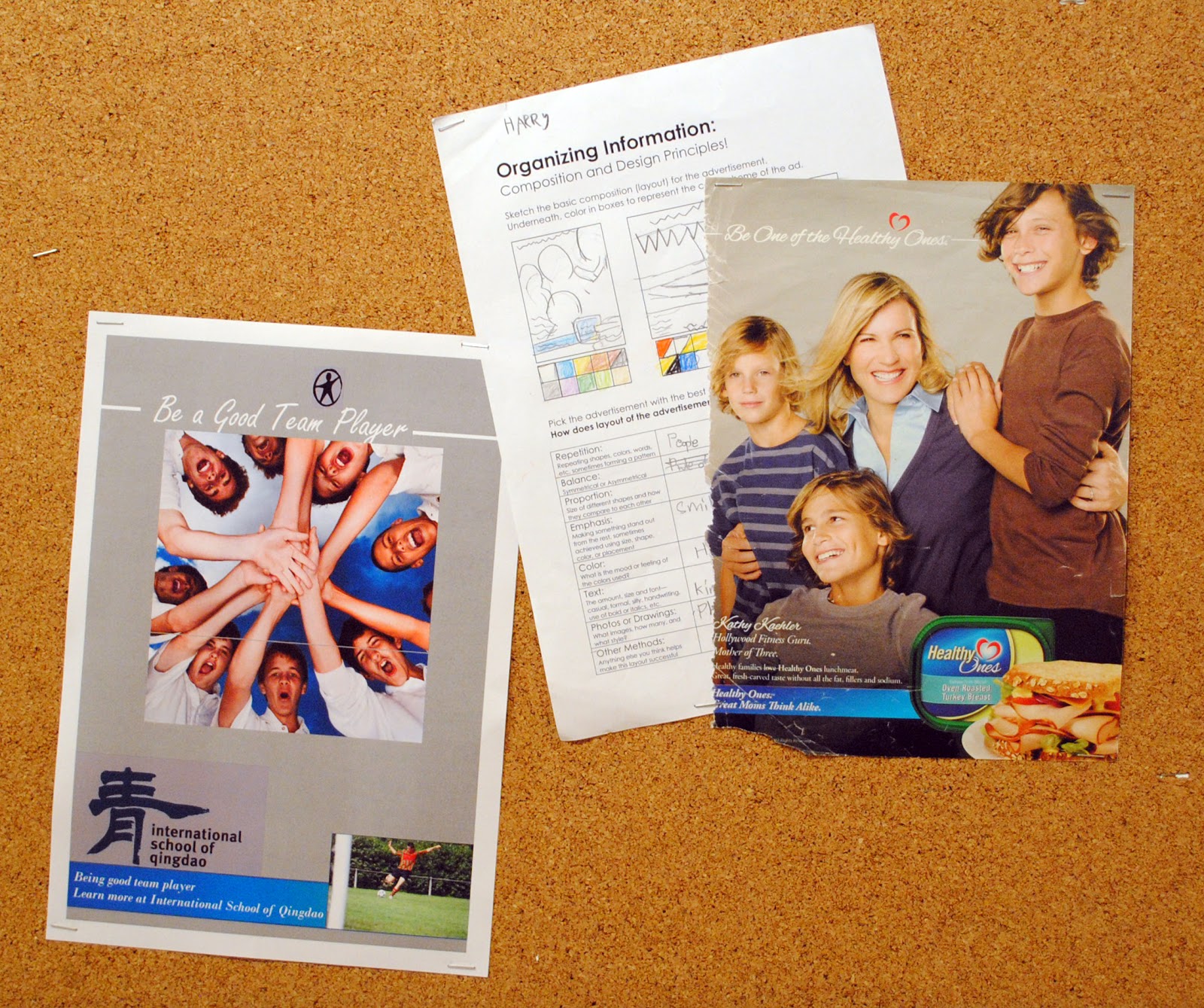
To begin to understand principles of art in graphic design, 5th graders analyze magazine advertisements. They sketch layouts, identify color palettes, and answer questions about style (text and images) and principles (repetition, emphasis, balance, proportion). Student then use a favorite advertisement as a template for advertising one of our Expected Schoolwide Learning Results (ESLRs).

The students create their advertisements in PowerPoint. We change the slide size and orientation, then use AutoShapes, Clip Art, and Text Boxes to create the ad. I like that the program is quicker to pick up than Photoshop, Illustrator, or InDesign. The skills they learn will transfer well to other Microsoft programs, which is handy as they enter middle school.

I do not allow the students to get images on the internet for numerous reasons, including the questionable results sprinkled in any Google image search and the quality of most of the images. If they cannot find what they want in clip art, I search for free stock photos and drop them into their folder on the network. I also give them access to the school logo and the newly designed ESLR icon.


This ad is one of my favorites. I love the use of the ESLR icon above the words. Perfect substitute for the heart!


After the images are added, I let the students vary from the original color palette. This girl decided to make her advertisement more interesting by eliminating the all-white background and adding more layers.


We don't exactly have a baseball program at our school, but I like this advertisement about learning good sportsmanship in PE class.


Po, from our production of Snow White and the Seven Dwarfs, made this advertisement. He gave me a shout-out in his ad! He replaced Benjamin Bratt's name with his own name and "Inspired by a True Story" with "Inspired by Miss M." Unfortunately, I asked all the students to remove their names from the posters, only identifying the posters by our school, and not by the designer.


The Captain (Doc) from Snow White just loved this interactive advertisement. He suggested using the ESLR icon in place of the can of Chef Boyardee, which prompted me to make the icon available to all the students. We carefully crafted a phrase that would work on his advertisement both when folded and unfolded. I love the final result!


Sunday, April 17, 2011

School Supply Drawings

Drawing from direct observation is one of my Visual Arts Standards and Benchmarks and a passion of mine. My second graders draw the hallway (a project I did in high school), my third graders draw bicycles (another project I did in high school), my fourth graders draw their classmates (also a project I did in high school), and my fifth graders draw their hands (yet another project I did in high school).

I do not think they are too young for such academic, classic drawing tasks. They are so successful! Of course, we do other projects that engage their kid culture in the arts, but I love teaching students how to see and how to reproduce what they see on paper.

When I saw these observational drawings on the Briargrove Elementary Art Page, I knew I had to tackle such a project with my second grade students.

I loved the drawing challenges:

        draw at least one object larger than life
        draw at least one object cropped (going off the edge of the page)
        draw at least one object repeated (from observation again)


I didn't have shells, fake flowers, or an abundance of potted plants. Instead, I found our everyday materials: paintbrushes, paint bottles, scissors, compasses, pencil sharpeners, glue bottles, etc. (Not surprisingly, I also had to draw school supplies from direct observation in high school.) While there is a benefit to drawing organic items (no intimidating straight lines and more forgiveness in mistakes, especially when drawing directly in permanent marker), my students rose to the challenge.

We learned that to observe means to LOOK! They needed to be constantly looking at the object they were drawing.

To add interest, they used crayons to draw textures, patterns, and solid colors in the objects with one color family (warm, cool, or neutral). Using a different color family, they added textures and patterns to the background. Finally, they used watercolors to paint the areas that were not covered by crayon. The results are fabulous!

Search This Blog

Total Pageviews


  © Blogger template Shush by Ourblogtemplates.com 2009

Back to TOP